
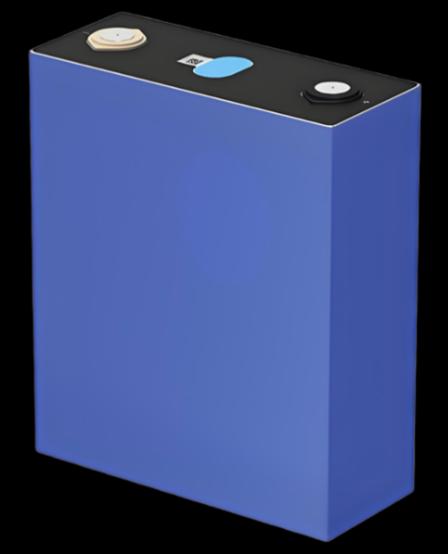
Description

Description
- Intrinsically safe sodium-ion chemistry: passes 8 safety tests (overcharge, over-discharge, short circuit, crush, thermal runaway, drop, etc.) with no fire and no explosion, per GB/T 44265-2024
- Excellent low-temperature performance: discharge energy ≥339.15Wh (~70%) at -40°C; ≥387.6Wh (~80%) at -20°C
- Ultra-long cycle life: retained energy ≥70% of nominal after 15,000 cycles at 25°C
- High rate capability: maximum continuous discharge power 1P; discharge energy ≥465Wh at 1P
- Low self-discharge: retained and recoverable energy ≥95% after 28 days storage at 25°C; recoverable energy ≥95% after 30 days at 45°C
- Low AC impedance ≤0.22mΩ (AC 1kHz, fresh cell) for reduced heating and high efficiency
- Lightweight standard format: 71.5 × 173.6 × 207.2 mm (incl. film / terminals), weight 4.73±0.10kg
Main specifications
| Parameter | Specification | Test condition |
|---|---|---|
| Nominal capacity | ≥170Ah | Standard charge/discharge conditions |
| Nominal energy | ≥484.5Wh | — |
| Nominal voltage | 2.85V | 25±2°C, standard charge/discharge |
| Charge cut-off voltage | 3.3V | 0°C ≤ T < 60°C |
| Discharge cut-off voltage | 1.5V | Above 0°C (contact manufacturer for applications below 0°C) |
| AC impedance | ≤0.22mΩ | Fresh cell, AC 1kHz |
| Operating temperature | Charge: 0~60°C Discharge: -40~60°C |
Power limits see charge/discharge tables below |
| Max. continuous charge power | 0.5P | — |
| Max. continuous discharge power | 1P | — |
| Weight | 4.73±0.10kg | — |
| Shipment SOC | 30~50% | — |
| Reference standard | GB/T 44265-2024 — Technical specification for sodium-ion batteries for electric power energy storage stations | |
| Applications | Energy storage, telecom | |
Dimensions (appearance subject to the physical product)
| Item | Dimension | Remark |
|---|---|---|
| Thickness T | 71.5±0.5mm | incl. wrap film |
| Width W | 173.6±0.3mm | incl. wrap film |
| Height H | 207.2±0.5mm | incl. terminals |
Temperature–capacity, storage and cycle life
| Item | Specification | Condition |
|---|---|---|
| -40°C discharge energy | ≥339.15Wh | Std. charge, then 0.5P constant-power discharge to 1.5V at -40±2°C |
| -20°C discharge energy | ≥387.6Wh | Std. charge, then 0.5P constant-power discharge to 1.5V at -20±2°C |
| 0°C discharge energy | ≥436.05Wh | Std. charge, then 0.5P constant-power discharge to 1.5V at 0±2°C |
| 25°C discharge energy | ≥484.5Wh | Std. charge, then 0.5P constant-power discharge to 1.5V at 25±2°C |
| 45°C discharge energy | ≥484.5Wh | Std. charge, then 0.5P constant-power discharge to 1.5V at 45±2°C |
| 60°C discharge energy | ≥484.5Wh | Std. charge, then 0.5P constant-power discharge to 1.5V at 60±2°C |
| 0.5P discharge energy (25°C) | ≥484.5Wh | After standard charge |
| 1P discharge energy (25°C) | ≥465Wh | After standard charge |
| 25°C / 28 days storage | Retained energy ≥95% Recoverable energy ≥95% |
Full-charged cell stored at 25±2°C for 28 days, measured with standard charge/discharge |
| 45°C / 30 days storage | Retained energy ≥92% Recoverable energy ≥95% |
Full-charged cell stored at 45±2°C for 30 days, measured with standard charge/discharge |
| Cycle life | Retained energy ≥70% of nominal after 15,000 cycles | 25±2°C, cells clamped on large faces with 3000±200N; cycle: 0.5P constant-power charge to 3.3V → rest 10–30min → 0.5P constant-power discharge to 1.5V → rest 10–30min |
Note: actual cycle life is strongly affected by external pressure and temperature. Product appearance and packaging are subject to the physical item.
Charge temperature–current limits (0–100% SOC)
| Temperature (°C) | 0 | 5 | 10 | 15 | 20 | 25 | 45 | 50 | 55 | 60 |
|---|---|---|---|---|---|---|---|---|---|---|
| Max. continuous charge current (P) | 0.05 | 0.05 | 0.1 | 0.25 | 0.25 | 0.5 | 1 | 0.5 | 0.5 | 0 |
Discharge temperature–current limits
| Temperature range (°C) | SOC 10%-30% | SOC 30%-60% | SOC 60%-100% |
|---|---|---|---|
| -40~-20 | 0.5 | 0.5 | 0.5 |
| -20~30 | 1.0 | 1.0 | 1.0 |
| 30~45 | 0.5 | 0.5 | 0.5 |
| 45~60 | 0.25 | 0.25 | 0.25 |
Safety performance
| Item | Test method | Criterion |
|---|---|---|
| Over-discharge test | GB/T 44265-2024 cl. 6.7.1.2.1 | No fire, no explosion |
| Overcharge test | GB/T 44265-2024 cl. 6.7.1.1.1 | No fire, no explosion |
| Short-circuit test | GB/T 44265-2024 cl. 6.7.1.4.1 | No fire, no explosion |
| Adiabatic temperature rise test | GB/T 44265-2024 cl. 6.7.4.1 | No fire, no explosion |
| Crush test | GB/T 44265-2024 cl. 6.7.2.1.1 | No fire, no explosion |
| Thermal runaway test | GB/T 44265-2024 cl. 6.7.4.2 | No fire, no explosion |
| Drop test | GB/T 44265-2024 cl. 6.7.2.2.1 | No fire, no explosion |
| Overload test | GB/T 44265-2024 cl. 6.7.1.3.1 | No fire, no explosion |
Terminal-to-busbar welding recommendations
| Item | Standard |
|---|---|
| Welding energy | ≤2000J |
| Welding power | <3500W |
| Welding speed | 60–90mm/s |
| Weld penetration | 0.5–2mm |
| Plastic part heat resistance | 200°C sustained <30s |
| Max. pressure on terminal | <1000N |
BMS protection parameters (datasheet clause 8.6)
| Item | Parameter | Protection action |
|---|---|---|
| Charge cut-off | 3.30V | BMS requests charge termination when cell voltage reaches 3.30V |
| Level-3 overcharge protection | 3.40V | BMS alarm when cell voltage reaches 3.50V |
| Level-2 overcharge protection | 3.50V | BMS forces charge termination when cell voltage reaches 3.60V |
| Level-1 overcharge protection | 3.60V | BMS forces charge termination at 3.65V and locks the BMS until a technician resolves the issue |
| Discharge cut-off | 1.50V | BMS requests discharge termination when cell voltage reaches 1.50V |
| Level-1 over-discharge protection | 1.45V | BMS alarm |
| Level-2 over-discharge protection | 1.40V | BMS forces discharge termination |
| Level-3 over-discharge protection | 1.30V | BMS forces discharge termination and locks the BMS until a technician resolves the issue |
| Short-circuit protection | Short circuit not allowed | Relay opens the circuit when a short occurs |
| Overcurrent protection | Current ≤323A | BMS keeps charge/discharge current within specification |
| Overheat protection | Cell temperature ≤60°C | Terminate charge/discharge when the limit is exceeded |
| Low-temperature protection | Charge ≥0°C / Discharge ≥-40°C | Terminate charge/discharge when below the limit |
Note: the overcharge / over-discharge items above are warning clauses. If a cell reaches any of these states it has left the operating conditions specified in the datasheet; quality issues caused by exceeding the protected voltage range or by over-discharge are not covered by any warranty.
Storage, transport and application notes
- Storage: 0–25°C, 65±20%RH, SOC 30–50%; for storage beyond 3 months, perform a standard charge/discharge cycle every 3 months; use within 6 months of receipt
- Transport: never ship with flammable, explosive or corrosive goods; no stacking of bulk packages; protect from rain, snow, liquids and mechanical damage; handle with lifts or dedicated tools
- Incoming inspection: complete within 15 days of receipt per the agreed inspection specification
- Assembly: apply a preload force of 3000±200N to the cells; a BMS monitoring every cell is mandatory; keep complete operating and test data records
- End of life: retire the cell when its capacity falls below 70% of nominal (at 25°C)
For the full datasheet (document no. MR-QES-03-JS01-C01) or special-application confirmation, contact the manufacturer: info@sunbrilo.com.hk